
Preventive Fleet Maintenance vs. Reactive Repairs: Which Actually Saves More Money?
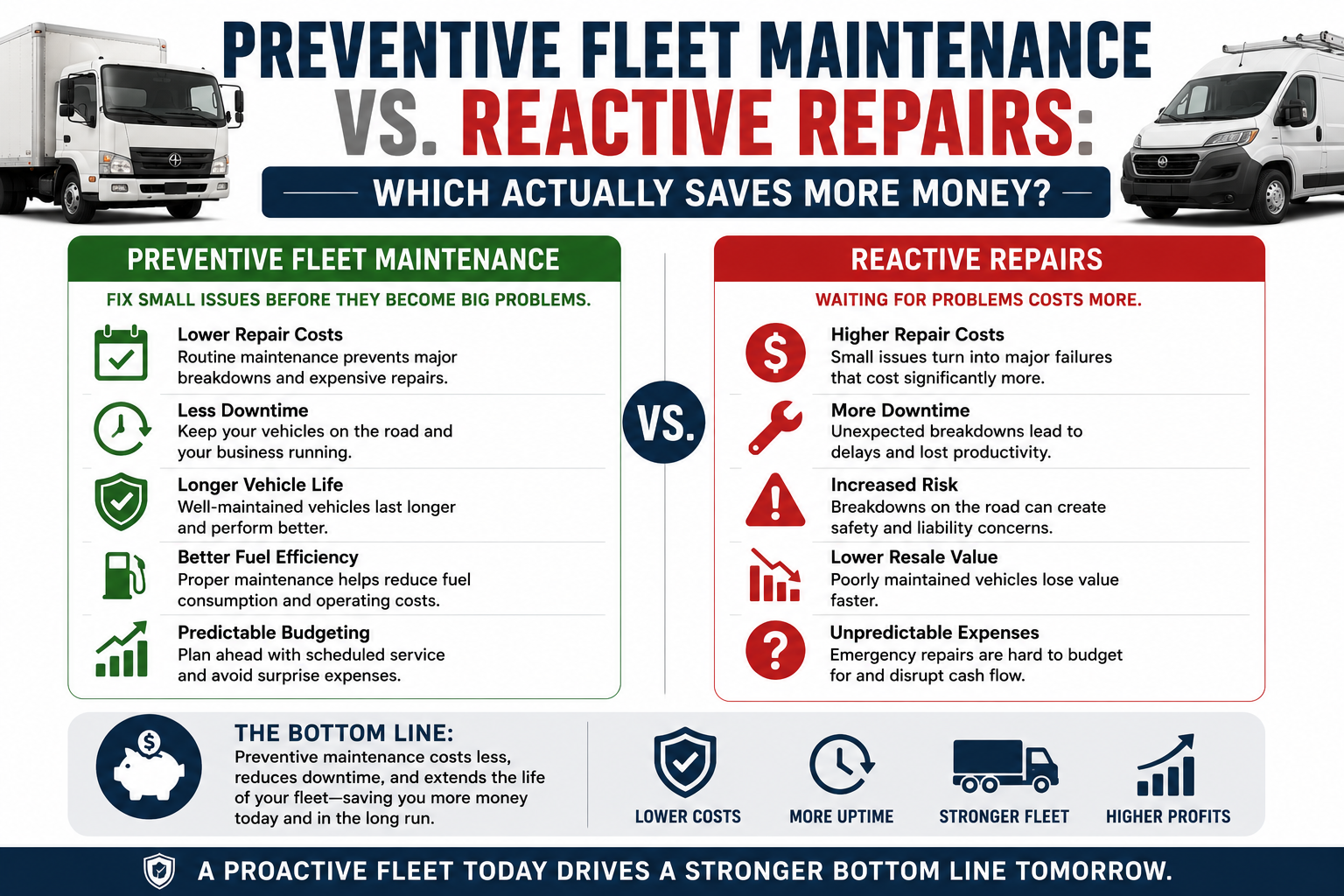
Most fleet managers already know preventive maintenance is important.
The real question is:
Does preventive maintenance actually save money, or does it simply spread repair costs out over time?
For most commercial fleets, the answer becomes clear when you look beyond the repair bill itself.
A brake job costs money.
An alignment costs money.
A tire rotation costs money.
But unexpected downtime costs money too—and for many businesses, downtime is the most expensive repair of all.
When fleet operators compare preventive maintenance to reactive repairs, the biggest costs often aren’t found on the repair invoice. They’re found in missed appointments, delayed deliveries, lost productivity, emergency towing, and vehicles that aren’t generating revenue.
Quick Answer: Which Is Cheaper?
In most cases, preventive fleet maintenance costs less over the life of the vehicle.
Not because repairs disappear.
Because they’re usually smaller, more predictable, and less disruptive.
The longer a fleet operates on a “fix it when it breaks” strategy, the more likely it becomes that small problems turn into expensive repairs involving multiple systems.
The Real Cost of Reactive Repairs
At first glance, reactive repairs sound like a smart financial decision.
You only spend money when something actually breaks.
The problem is that vehicle components rarely fail in isolation.
A Real Fleet Example
A service truck develops an alignment issue.
The vehicle still drives.
No one schedules service.
Six months later:
- The tires are worn out
- Fuel economy has declined
- Suspension components show additional wear
- The vehicle now needs tires, an alignment, and suspension work
What started as a relatively inexpensive alignment became a significantly larger repair.
This pattern repeats itself throughout commercial fleets.
The Cost Most Fleet Managers Forget to Calculate
When a vehicle breaks down unexpectedly, the repair isn’t usually the biggest expense.
The downtime is.
Hidden Costs of Fleet Downtime
- Missed deliveries
- Delayed appointments
- Overtime labor
- Emergency towing
- Rental vehicles
- Rescheduling crews
- Lost customer confidence
- Reduced productivity
A Simple Example
Imagine a service vehicle generates $1,000 per day in revenue.
An unexpected breakdown removes that vehicle from service for two days.
The repair itself may cost $500.
The downtime may cost $2,000.
In that scenario, the breakdown cost four times more than the actual repair.
Why Preventive Maintenance Works
Preventive maintenance focuses on finding problems before they affect operations.
Instead of waiting for failure, technicians monitor:
- Tire wear
- Brake condition
- Fluid condition
- Suspension components
- Steering systems
- Battery health
- Cooling systems
The goal isn’t eliminating repairs.
The goal is controlling when they happen.
Planned Downtime vs. Unplanned Downtime
Fleet managers can schedule maintenance.
They can’t schedule breakdowns.
A vehicle that’s serviced during a planned maintenance window doesn’t disrupt operations the same way a vehicle stranded on the side of the road does.
That difference has real financial value.
Tires Usually Cost More Than Fleet Managers Think
For many fleets, tires represent one of the largest operating expenses.
The problem is that tire wear often starts somewhere else.
What We See Regularly
A fleet manager replaces tires.
Six months later the replacements are already wearing unevenly.
The tires weren’t the problem.
The vehicle had:
- Alignment issues
- Suspension wear
- Steering component wear
- Tire pressure issues
The underlying cause was never corrected.
A $150 Alignment vs. A $1,200 Tire Bill
One of the most common examples of preventive maintenance paying for itself involves wheel alignments.
Ignoring a small alignment issue may save money today.
Replacing multiple commercial tires prematurely usually doesn’t.
That’s why routine tire inspections, alignments, and TPMS service often deliver some of the highest returns in a fleet maintenance program.
Brake Inspections Are Usually Cheaper Than Brake Repairs
Commercial vehicles often operate under demanding conditions.
Delivery vehicles, service trucks, and contractor fleets spend significant time in stop-and-go traffic.
That creates wear.
A Common Scenario
Brake pads wear down.
The vehicle still stops normally.
Service gets delayed.
Several months later the pads damage the rotors.
Now the repair includes:
- Brake pads
- Rotors
- Additional labor
- More downtime
The same principle applies throughout the fleet.
Early intervention almost always costs less than component failure.
Fuel Economy Has a Bigger Impact Than Most People Realize
Fleet maintenance affects more than repair costs.
It affects operating costs every day.
Small issues can reduce fuel economy, including:
- Underinflated tires
- Poor wheel alignment
- Worn suspension components
- Dirty air filters
- Engine performance issues
The Math Adds Up Quickly
If a fleet vehicle travels 30,000 miles per year and loses just 1 MPG due to poor maintenance, the additional fuel cost becomes significant.
Multiply that across multiple vehicles and the annual expense can exceed the cost of the maintenance that would have prevented it.
The Advantage of Predictable Expenses
One of the biggest benefits of preventive maintenance is predictability.
Fleet managers can budget for:
- Inspections
- Tire replacement
- Brake service
- Fluid maintenance
- Scheduled repairs
Unexpected breakdowns don’t offer that luxury.
They arrive without warning and often require immediate action.
Predictable maintenance costs are generally easier to manage than unpredictable emergency expenses.
What the Best Fleet Operators Focus On
The most successful fleet operators rarely ask:
“How long can we wait?”
Instead they ask:
“What will this cost if we don’t address it now?”
That shift in thinking changes everything.
Because fleet maintenance isn’t really about repairs.
It’s about uptime.
Every maintenance decision ultimately comes down to one question:
Does this keep vehicles on the road generating revenue?
If the answer is yes, it’s often a worthwhile investment.
Choosing the Right Fleet Service Partner
Preventive maintenance works best when inspections are thorough and recommendations are practical.
Fleet operators need more than a repair shop.
They need a partner that understands:
- Downtime costs
- Vehicle utilization
- Tire management
- Preventive scheduling
- Commercial vehicle priorities
At Cook Tire & Service Center, we help East Texas fleet operators reduce unexpected breakdowns through comprehensive inspections, commercial tire management, brake service, alignments, suspension repairs, diagnostics, and preventive maintenance programs designed around real-world fleet operations.
Fleet Maintenance Isn’t a Repair Strategy—It’s a Business Strategy
Every fleet experiences repairs.
The question is whether those repairs happen on your schedule or the vehicle’s schedule.
Preventive maintenance won’t eliminate every breakdown.
What it does is reduce surprises, improve reliability, extend component life, and help businesses control one of their largest operating expenses.
For most commercial fleets, that’s where the real savings occur.