
How Much Does an Oil Change Cost in 2026-27? Conventional, Synthetic, High-Mileage, and Diesel Oil Change Prices Explained
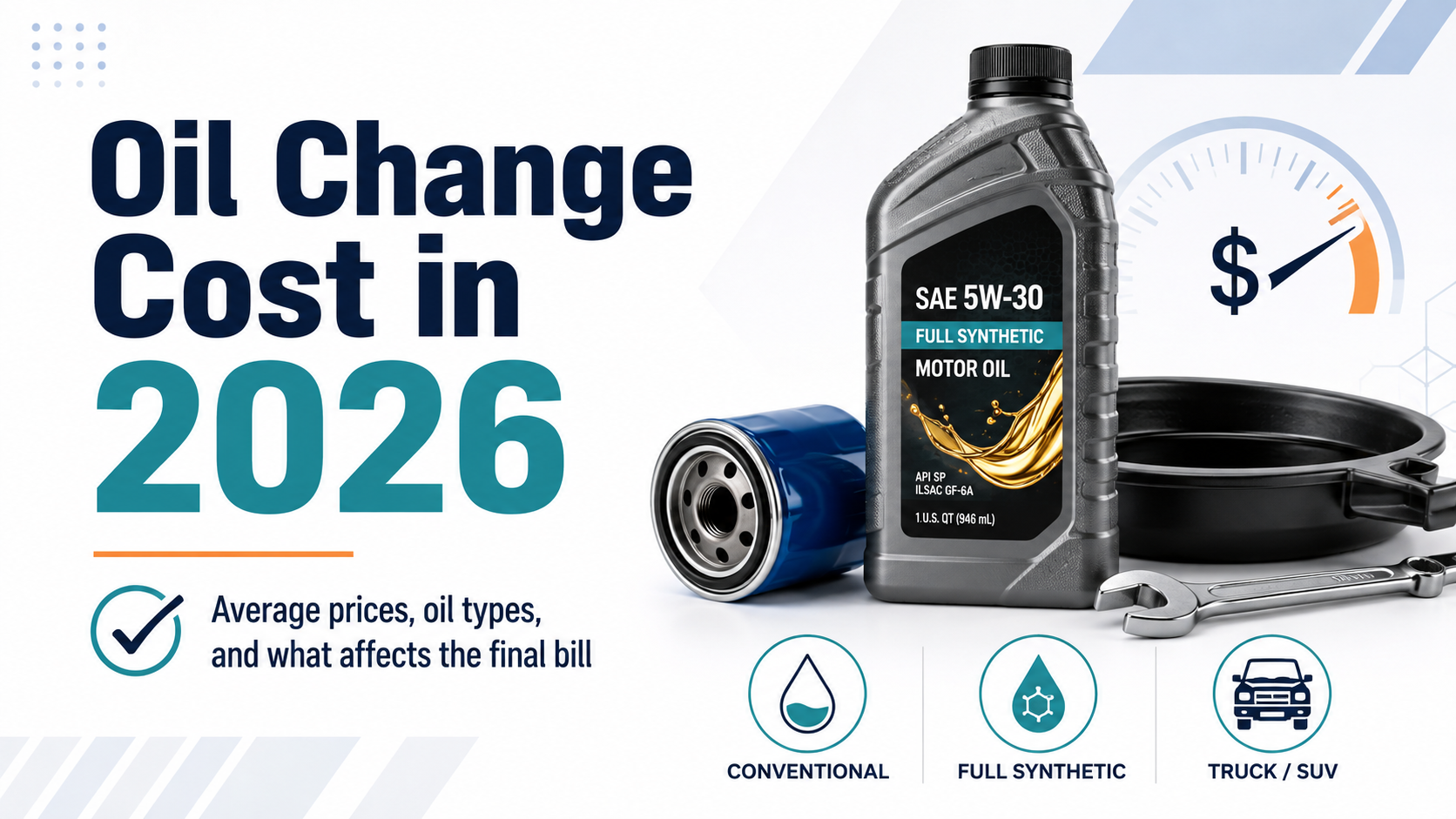
An oil change is one of the most familiar forms of vehicle maintenance, but the price is no longer as predictable as it once was.
One shop may advertise a $29.99 oil change. Another may quote $89 for the same vehicle. A newer truck, European car, diesel pickup, or engine requiring a specialized low-viscosity synthetic oil can push the total well above $100. Even two vehicles parked in the same driveway may have very different oil-change costs because they use different oil specifications, quantities, filters, and service procedures.
So, how much does an oil change cost in 2026?
As a broad national estimate, a conventional oil and filter change typically costs about $35 to $75, while a full-synthetic oil change typically costs $65 and $125.
Larger engines, premium filters, diesel applications, European oil approvals, high oil capacities, difficult filter access, and additional inspection or maintenance services can raise the total to $100 to $200 or more. Current consumer price guides continue to place conventional and synthetic service within those general ranges, but oil and supply costs have faced additional upward pressure during 2026.
That does not mean every $120 oil change is overpriced, nor that every $35 offer is a bargain.
The real value depends on what is included, whether the correct oil and filter are used, how much oil the engine requires, and whether the service is performed carefully. A cheap oil change becomes expensive when the engine is underfilled, the drain plug is damaged, the wrong oil specification is installed, or a leak goes unnoticed.
Hunt’s Car Care provides professional oil change service in Kearney, MO, using quality motor oil and filters while checking the vehicle for developing maintenance concerns. Drivers can also combine their oil change with preventive maintenance, tire rotation, inspections, and other services based on the vehicle’s needs. Hunt’s currently advertises a full-synthetic oil change promotion that includes full-synthetic oil, a premium filter, fluid-level checks, and a courtesy vehicle inspection, although promotional availability and final vehicle-specific pricing can change.
Average Oil Change Cost in 2026/2027
The following ranges are useful for planning, but they should not be treated as fixed prices for every vehicle.
| Oil-change type | Typical 2026 price range |
| Conventional oil change | $35-$75 |
| Synthetic-blend oil change | $45-$90 |
| Full-synthetic oil change | $65-$125 |
| High-mileage oil change | $60-$130 |
| European or specialty synthetic service | $90-$180+ |
| Diesel pickup oil change | $100-$250+ |
| Large-capacity truck or SUV | $90-$175+ |
| DIY oil and filter change | Approximately $30-$90+ |
These estimates assume a relatively straightforward oil and filter service. Prices may increase when the engine needs more than five quarts, uses an expensive cartridge filter, requires a manufacturer-approved oil, has difficult access, or needs a replacement drain plug, filter cap, skid-plate hardware, or oil-level sensor diagnosis.
Why Are Oil Changes Becoming More Expensive in 2026?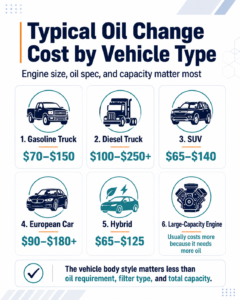
Oil changes are becoming more expensive in 2026 because shops are paying more for labor, insurance, transportation, filters, equipment, supplies, and manufacturer-approved oils.
Synthetic oil costs have also increased as supplies of Group III base oils tightened, prompting some shops to raise routine oil-change prices from roughly $80-$100 to $100—$120 or more. Actual pricing varies by location, vehicle, oil specification, and how the shop purchases its supplies, so oil change costs are best viewed as a range rather than a single national average.
Why Oil Type Changes the Price
Motor oil is not one uniform product.
The correct oil must match the engine’s viscosity and performance specifications. The American Petroleum Institute’s oil categories and certification marks identify products that meet established performance standards, while the vehicle owner’s manual remains the primary source for the required viscosity, specification, and service category. API specifically advises vehicle owners to consult the manufacturer’s recommendations when choosing an oil.
Conventional Motor Oil
Conventional oil is refined from petroleum-based stocks and combined with an additive package.
It is commonly the least expensive option, but fewer modern vehicles specify it. Newer turbocharged, direct-injected, hybrid, and high-efficiency engines frequently require synthetic or synthetic-blend products meeting more demanding manufacturer standards.
Conventional oil may still be appropriate for:
- Certain older vehicles
- Engines whose manuals permit it
- Vehicles driven relatively few miles
- Applications using shorter service intervals
- Drivers seeking a lower upfront price
The fact that conventional oil costs less does not make it automatically inferior for an engine designed to use it. The problem occurs when it is installed in an engine requiring a higher-performing synthetic formulation or a specific approval it does not meet.
Synthetic-Blend Oil
Synthetic-blend oil combines conventional and synthetic base stocks.
It is intended to offer improved performance compared with basic conventional oil without costing as much as a full-synthetic product.
Synthetic blends have been common in trucks, SUVs, fleet vehicles, and vehicles whose manufacturers specify a blend or permit several oil types.
The exact proportion of synthetic content can vary. “Synthetic blend” is a broad product category, not a promise that every blend contains the same percentage or delivers the same performance.
Full-Synthetic Oil
Full-synthetic motor oil is formulated to provide controlled performance across a broad range of temperatures and operating conditions.
Depending on the product and specification, synthetic oil may offer improved:
- Low-temperature flow
- High-temperature stability
- Oxidation resistance
- Deposit control
- Turbocharger protection
- Fuel-economy performance
- Resistance to viscosity breakdown
The price is higher because of the base oils, additive package, licensing, testing, manufacturing, and vehicle-specific requirements involved.
A full-synthetic oil change commonly costs $65 to $125, but large-capacity or specialty applications may exceed that range.
High-Mileage Oil
High-mileage oil is generally marketed for vehicles with approximately 75,000 miles or more, although mileage alone does not determine whether it is necessary.
These products may contain additive packages intended to support older seals, control deposits, reduce consumption, or provide additional protection in aging engines.
High-mileage oil does not rebuild worn piston rings, repair a leaking gasket, restore failed oil pressure, or correct serious mechanical wear.
It may be useful when an older engine:
- Consumes a modest amount of oil
- Has minor seepage
- Has accumulated significant mileage
- Operates under severe conditions
- Benefits from a formulation designed for aging seals and deposits
The cost is often similar to or slightly higher than a comparable synthetic or synthetic-blend service.
European and Manufacturer-Approved Oil
A bottle labeled “full synthetic” may still be wrong for a European or performance vehicle.
Many BMW, Mercedes-Benz, Volkswagen, Audi, Porsche, Volvo, and other manufacturers require oils carrying specific approvals. Those approvals can address oxidation, wear, emissions-system compatibility, extended drains, deposit control, and performance under manufacturer-defined tests.
Specialty oils can cost more because they may be:
- Produced in lower volumes
- Required to meet additional approvals
- Imported or distributed through specialized channels
- Sold in liter containers
- Paired with more expensive cartridge filters
- Needed in engines with larger oil capacities
A European synthetic oil change may cost $90 to $180 or more, especially if the engine needs seven, eight, nine, or more quarts.
Diesel Engine Oil
Diesel oil changes can cost considerably more because diesel engines often hold more oil and use larger or multiple filters.
A heavy-duty diesel pickup may require:
- 10 to 15 quarts of engine oil
- A diesel-specific API category
- A larger filter
- More labor for skid plates or access
- Fuel-filter inspection or replacement
- Additional maintenance checks
API distinguishes gasoline-engine “S” service categories from diesel-engine “C” and “F” categories. Some diesel oil categories are not interchangeable, particularly in newer applications, making the manufacturer’s specification essential.
A diesel pickup oil change can therefore cost $100 to $250 or more without being unusually priced.
How Oil Capacity Changes the Final Price
Suppose a full-synthetic special covers five quarts for $79.99 and the vehicle requires eight quarts. If each additional quart costs $10 to $15, the final total may reach $110 to $125 before taxes or shop fees.
The shop should confirm the complete capacity before providing a final estimate.
How Much Does a DIY Oil Change Cost in 2026?
A do-it-yourself oil change can cost approximately $30 to $90 or more, depending on the oil quantity, filter, tools, and whether products are purchased on sale.
A basic DIY breakdown might include:
| Item | Approximate cost |
| Five quarts of conventional oil | $20-$35 |
| Five quarts of full synthetic | $25-$50+ |
| Oil filter | $7-$25+ |
| Drain-plug washer or seal | $1-$5 |
| Disposal | Often free at participating collection locations |
| Initial tools and equipment | $50-$250+ |
Initial equipment may include:
- Floor jack
- Jack stands or ramps
- Drain pan
- Filter wrench
- Correct sockets
- Torque wrench
- Funnel
- Gloves
- Wheel chocks
DIY maintenance can save money when the owner has a safe work area, correct service information, tools, and experience.
It can become expensive when:
- The vehicle falls from improper supports.
- The drain plug is stripped.
- The filter seal doubles up.
- The engine is underfilled or overfilled.
- The wrong oil is installed.
- Oil is poured into the wrong opening.
- The old filter remains loose.
- Underbody hardware is damaged.
- A leak is not noticed.
A professional oil change also creates a service record and an opportunity to identify issues with tires, brakes, leaks, belts, hoses, or and other developing problems.
How Much Does a Truck Oil Change Cost?
A gasoline truck oil change often costs $70 to $150, depending on oil quantity and specification.
A diesel truck may cost $100 to $250 or more.
Truck pricing is affected by:
- Six-, eight-, or ten-quart capacities
- Larger filters
- Diesel-specific oils
- Skid plates
- Commercial-duty use
- Additional grease fittings
- Fuel-filter service
- Dual-filter systems
- Extended inspection needs
A pickup does not automatically need the most expensive oil. It needs the correct engine oil for the operating conditions.
How Much Does an SUV Oil Change Cost?
Most gasoline SUVs fall within approximately $65 to $140 for a synthetic service.
Compact crossovers with four-cylinder engines may remain near the lower end. Large V8 SUVs, luxury models, performance SUVs, and vehicles with high oil capacity may cost more.
The body style is less important than the engine, oil specification, filter, and quantity.
How Much Does a European Car Oil Change Cost?
A European oil change often costs $90 to $180 or more.
Reasons include:
- Manufacturer-approved oil
- Larger oil capacity
- Liter-based packaging
- Premium cartridge filters
- Specialized tools
- Underbody-panel removal
- Electronic level checks
- Maintenance-system resets
A low advertised oil-change price may not include the oil approval your vehicle requires.
Before approving service, ask whether the oil meets the exact BMW, Volkswagen, Mercedes-Benz, Porsche, or other manufacturer specification listed in the owner’s manual.
How Much Does an Oil Change Cost for a Hybrid?
A hybrid oil change often costs about the same as one for a comparable gasoline vehicle: approximately $65 to $125 for full synthetic.
The gasoline engine may operate less continuously, but it still requires the correct oil and intervals.
Hybrid operating patterns can involve:
- Frequent engine starts and stops
- Extended periods when the engine is off
- Short engine run times
- Specialized low-viscosity oils
- Vehicle-specific maintenance resets
The presence of a hybrid battery does not eliminate engine oil maintenance.
Why a $29.99 Oil Change May Cost More at Checkout
An advertised price may apply only to:
- Conventional oil
- Five quarts
- A standard filter
- Selected vehicles
- A specific service package
- Customers presenting a coupon
- Service before taxes and shop fees
Common additional charges include:
- Extra quarts
- Full-synthetic upgrade
- High-mileage upgrade
- Specialty filter
- Diesel oil
- European specification
- Skid-plate labor
- Oil-disposal or shop fee
- Drain-plug replacement
- Filter-housing seal
- Sales tax
This does not necessarily mean the advertisement is deceptive. It means the customer should request the out-the-door vehicle-specific price.
Ask:
“What will this oil change cost for my exact year, make, model, engine, and oil specification, including all quarts, filter, fees, and tax?”
How to Save Money on an Oil Change
Check Current Promotions
Coupons can reduce the cost of full-synthetic service without changing the oil or filter quality.
Hunt’s Car Care maintains a current promotions page and, as of the latest available information, advertises a discount on qualifying full-synthetic oil-change service. Offers, exclusions, and expiration dates are subject to change.
Request the Complete Price Before Service
Provide:
- Year
- Make
- Model
- Engine size
- Mileage
- Oil specification, if known
Ask whether the estimate includes extra quarts, filter, fees, and tax.
Follow the Correct Interval
Changing oil unnecessarily early increases annual maintenance costs. Waiting too long can increase engine wear.
Follow the owner’s manual and oil-life monitor rather than a generic sales sticker.
Combine Services Carefully
Pairing an oil change with tire rotation, inspection, or maintenance can save a separate trip and identify problems early.
Do not approve unnecessary add-ons merely because the car is already in the shop.
Check for Leaks and Consumption
An engine that loses oil between changes may require repeated top-offs. Repairing a leak can reduce oil purchases and prevent damage.
Maintain Records
Good service records help prevent duplicate work and support warranty or resale documentation.
Oil Change Service in Kearney, MO
An oil change in 2026 may cost anywhere from about $35 for a straightforward conventional service to $150 or more for a large-capacity, diesel, European, or specialty synthetic application.
The correct price depends on what your vehicle actually requires.
Before choosing a service based on the lowest advertised number, confirm:
- Required oil viscosity
- Required API, ILSAC, or manufacturer approval
- Full engine capacity
- Filter type
- Extra-quart charges
- Included inspection
- Shop and disposal fees
- Tire-rotation availability
- Out-the-door total
Hunt’s Car Care provides professional oil changes in Kearney, MO for cars, trucks, and SUVs. Its technicians can also review the vehicle’s preventive maintenance schedule, rotate the tires, inspect fluid levels, and identify issues before they require larger repairs. Hunt’s emphasizes following the manufacturer’s maintenance recommendations rather than using one generic interval for every vehicle.
Drivers dealing with warning lights, unusual engine noise, low oil pressure, oil consumption, leaks, or poor performance can schedule engine diagnostic service or check engine light repair.
You can also review current service promotions or learn more about Hunt’s complete auto repair services in Kearney.
Hunt’s Car Care Kearney is located at 680 Centerville Avenue in Kearney, Missouri, and provides oil changes, preventive maintenance, diagnostics, brakes, cooling system repairs, tires, and other vehicle services for drivers throughout Kearney and the surrounding Kansas City area.