
Do You Need a New Oil Filter With Every Oil Change?
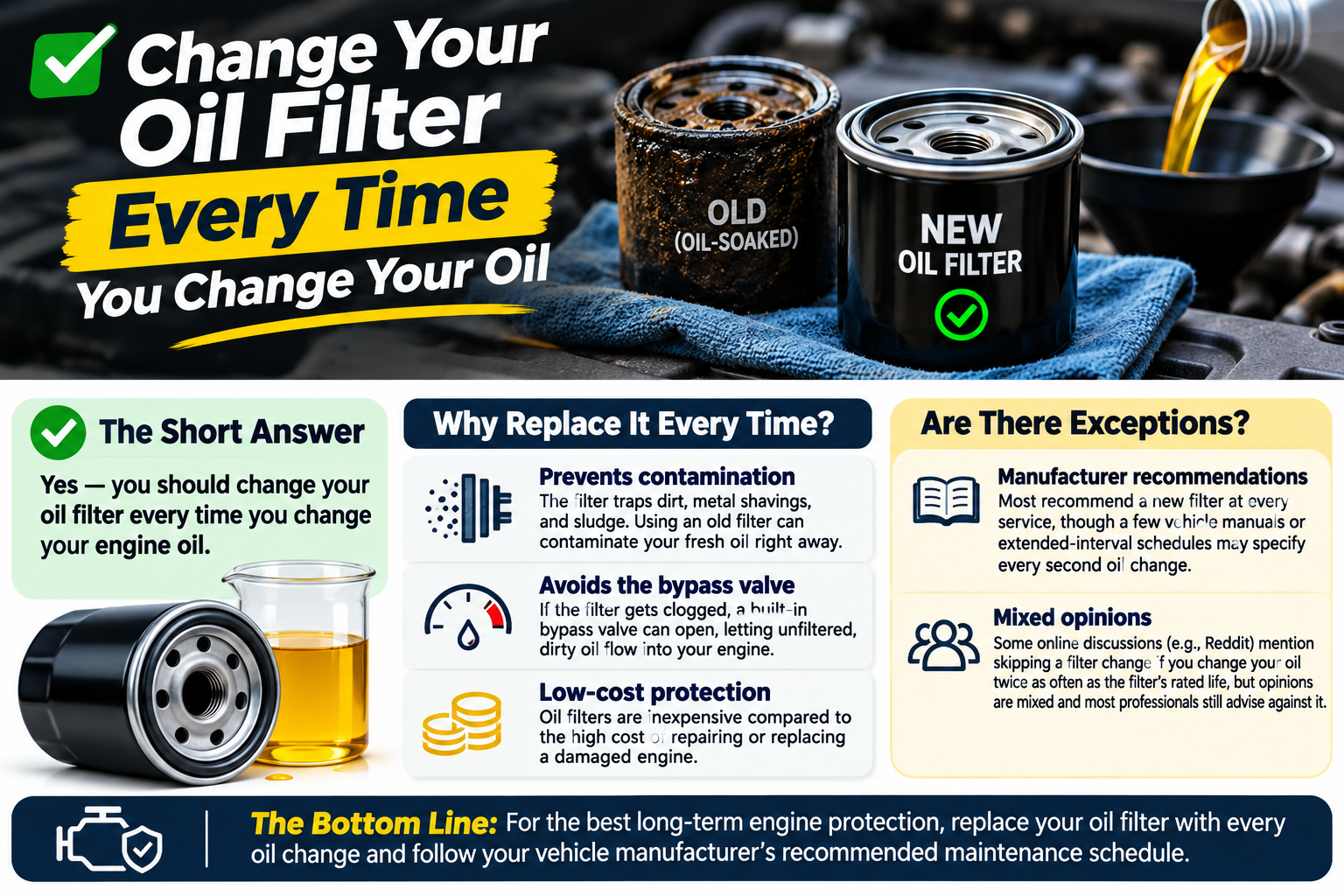
Yes, you should generally replace your oil filter every time you change your engine oil. Your oil filter removes dirt, metal particles, and other contaminants that accumulate as your engine runs. Replacing it during every oil change helps keep fresh oil clean and protects critical engine components.
Why Replacing Your Oil Filter Matters
-
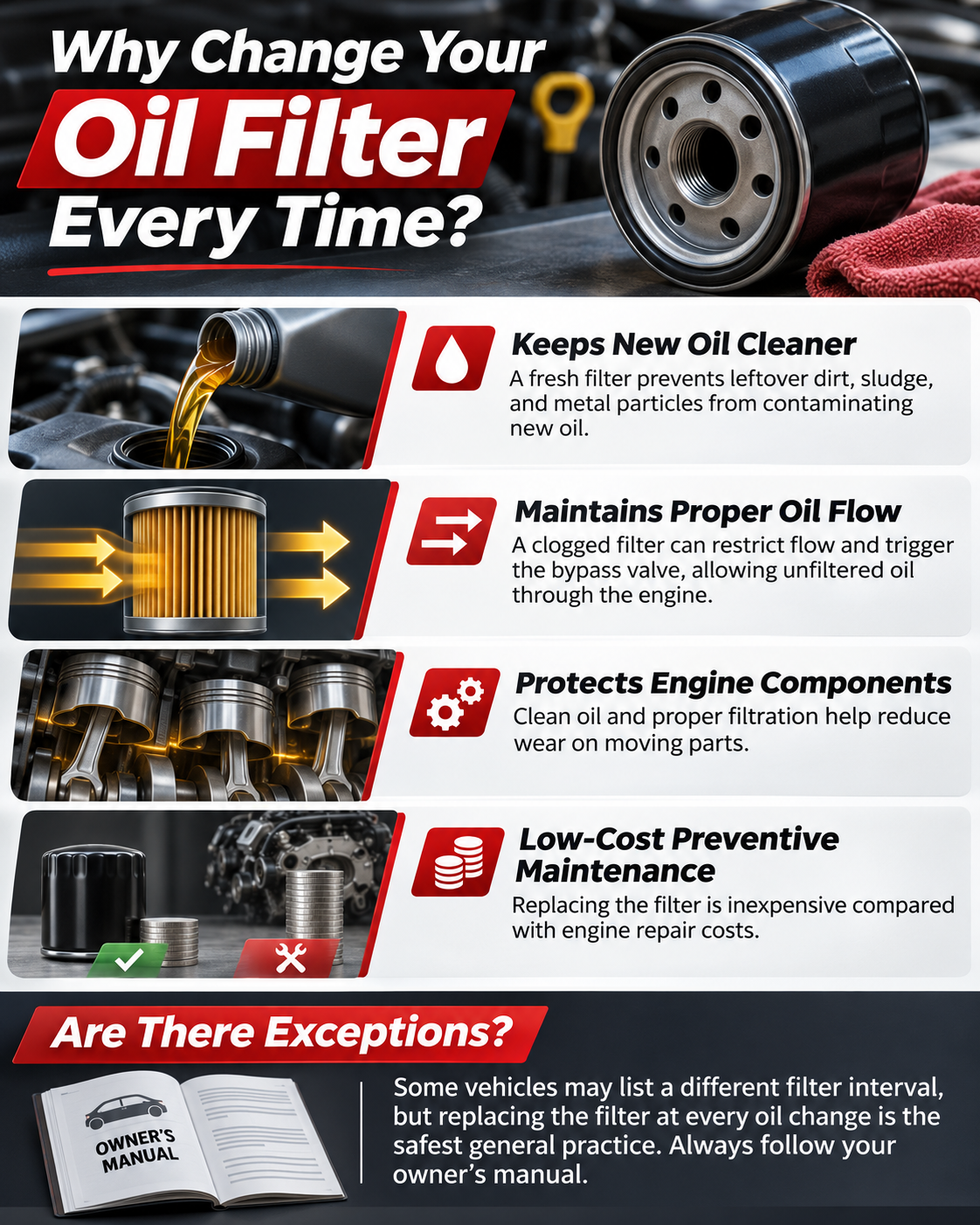
Keeps New Oil Cleaner: An old oil filter contains contaminants collected during the previous oil change interval. Replacing it prevents residual debris and dirty oil from mixing with your fresh engine oil.
-
Helps Maintain Proper Oil Flow: As an oil filter collects debris, it becomes more restrictive. If the restriction becomes excessive, the engine’s oil filter bypass valve may open, allowing oil to circulate without passing through the filter.
-
Protects Your Engine: Clean oil helps reduce friction and wear on moving engine components. A properly functioning oil filter supports lubrication and helps protect your engine over time.
-
Provides Affordable Preventive Maintenance: Oil filters are relatively inexpensive, especially compared to the cost of repairing engine damage caused by inadequate lubrication or excessive wear.
Can You Skip Changing the Oil Filter?
Some vehicle manufacturers specify oil filter replacement intervals that differ from their oil change intervals. However, replacing the filter with every oil change is generally the recommended practice, unless your vehicle’s maintenance schedule specifies otherwise.
Even if you change your oil more frequently than required, installing a new filter ensures that your fresh oil passes through a clean filter with its full service life available.
What Does the Oil Filter Do?
Engine oil travels through the lubrication system, protecting moving surfaces and carrying contaminants.
The oil filter removes certain particles from that flow.
Those particles can include wear debris and other material that should not continue circulating through the engine.
The filter is not a substitute for changing the oil. It does not fully remove dissolved fuel, restore depleted additives, or reverse every chemical change that occurs during use.
Oil and filtration perform related but different jobs.
The service schedule accounts for both.
A clean filter cannot make worn-out oil new, and new oil cannot make a used filter new.
Why Replace the Filter With the Oil?
Replacing both creates a known starting point.
You know when the oil entered service, when the filter entered service, and which interval applies.
Keeping the old filter introduces uncertainty about its accumulated contamination and remaining useful capacity.
Filter manufacturer FRAM generally recommends replacing the filter when the oil is changed, while emphasizing manufacturer guidance. Source: FRAM
That recommendation is not based on the idea that every used filter instantly ruins fresh oil.
The more accurate concern is that the filter has already completed part or all of its intended service and should not be assumed ready for another interval.
What Happens as a Filter Loads With Contaminants?
The filter’s media holds captured material.
As contamination accumulates, resistance to flow can increase.
Many engine lubrication systems include a bypass arrangement that allows oil to continue reaching the engine when the pressure difference across the filter becomes too high.
The bypass may be part of the filter or located elsewhere in the engine.
Its purpose is to maintain oil flow under specified conditions, such as cold operation or with a restricted filter.
It is a protective feature, not permission to neglect filter service.
Repeatedly relying on bypass because a filter is overloaded defeats part of the filtration system’s purpose.
Does the Bypass Valve Mean the Filter Is Optional?
No.
The engine needs oil flow, but it also benefits from filtration.
A bypass system balances those needs under conditions where forcing all flow through the filter would create excessive restriction.
Filter manufacturer MANN-FILTER describes bypass and anti-drainback functions as application-dependent aspects of oil filter design. Source: MANN-FILTER
The correct filter must match the vehicle’s requirements.
A filter that threads onto the engine is not necessarily suitable in every other respect.
Dimensions, sealing, bypass characteristics, and internal construction can matter.
Spin-On vs. Cartridge Filters
A spin-on filter includes its media inside a replaceable housing.
A cartridge arrangement typically replaces the filter element within a reusable housing on the engine.
Both require the correct part and installation procedure.
For a spin-on filter, the old gasket must not remain stuck to the engine’s sealing surface.
For a cartridge system, seals must be placed correctly, and the housing must be tightened as specified.
Reusing or misplacing a seal can cause leakage.
The design changes how the service is performed, but it does not eliminate the need for maintenance.
Does Synthetic Oil Let You Keep the Filter Longer?
Not automatically.
Synthetic oil can support specific service intervals when the vehicle and oil requirements allow.
The filter must also be suitable for that service.
Installing synthetic oil does not upgrade an existing filter’s capacity or construction.
Similarly, an extended life filter does not automatically authorize extending the oil interval.
The oil, filter, engine, and driving conditions need to fit the same maintenance plan.
For most owners, the practical approach is to follow the manufacturer’s oil-and-filter schedule rather than trying assigning separate unofficial intervals.
What About Filters Advertised for Extended Mileage?
Some filters are marketed for longer service under stated conditions.
Those claims depend on the product, application, and instructions.
They should not be interpreted as permission to ignore the vehicle manufacturer’s requirements.
A filter might have capacity beyond a shorter oil interval, but that does not automatically make reusing it the best maintenance choice for your vehicle.
Check the manufacturer’s schedule and the filter’s application guidance.
If an unusual maintenance strategy is being considered, it should be deliberate and documented.
It should not happen simply because the filter looks clean.
Can You Tell Whether a Filter Is Still Good?
Not reliably from the outside.
A clean metal canister does not show how much contamination the media has collected.
A cartridge element may reveal visible damage or debris upon removal, but appearance alone does not establish a safe service interval.
Likewise, the engine may run normally while a filter is overdue.
The absence of a warning light is not a filter condition test.
Routine replacement is based on the maintenance schedule because drivers cannot easily measure all relevant filter properties at home.
Are There Exceptions to Replacing It Every Time?
Vehicle-specific schedules can differ.
An unusually early oil change performed for a specific diagnostic or repair reason may also lead to a different decision.
Those cases should be handled in accordance withe the applicable service procedure.
They do not establish a general rule that every driver should replace the filter only every second oil change.
If your manual appears to specify a different interval, have the shop confirm the correct interpretation for your engine and operating conditions.
The purpose is to follow the right schedule, not to apply a slogan.
Why the Correct Filter Matters
Filters are application specific.
A part can differ in thread size, gasket location, dimensions, media, internal valves, or other characteristics.
Using an incorrect filter can cause leakage, inadequate filtration, or other lubrication problems.
The oil filter should be selected using accurate vehicle and engine information.
That matters particularly when a model offers several engines or when parts have changed across model years.
If the engine has been replaced, tell the shop.
The correct part may depend on the engine currently installed, rather than solely on the vehicle’s original identification.
Can You Replace Only the Filter?
It may be physically possible in some circumstances, but it is not a substitute for a due oil change.
Replacing the filter leaves most of the used oil and its operating history in place.
It may also require restoring the oil level afterward.
A filter-only replacement can be appropriate for a specific repair or service procedure, but the reason should be clear.
If your goal is routine maintenance, use the complete oil-and-filter service specified for the vehicle.
Can You Change the Oil Without Replacing the Filter?
Oil can be drained and refilled while a filter remains installed, but physical possibility is not the same as good routine practice.
The used filter continues operating with its existing contamination load.
Some old oil also remains in the system regardless of the exact service procedure, but the main issue is not achieving laboratory-level removal of every drop.
It is maintaining the filter and oil on an appropriate schedule.
Trying to save a small amount on the filter can create uncertainty that is difficult to justify.
What Should a Proper Oil-and-Filter Service Include?
A complete service begins with verifying the required oil and filter.
The technician drains the old oil, replaces the filter and applicable seals, reinstalls components according to the specified procedure, and refills with the correct oil quantity.
The final level should be verified using the vehicle’s procedure.
The engine and serviced areas should be checked for leaks.
If a maintenance reminder applies, it should be reset after the work is complete.
The invoice should document the service.
Hunt’s Car Care offers automotive maintenance in Kearney, including oil changes and related service needs.
Warning Signs After an Oil Change
Pay attention to new oil spots, an unusual smell, or a warning light.
A small amount of residual spilled oil can sometimes create a temporary smell, but persistent leakage or smoke should not be dismissed.
An oil pressure warning while the engine is running requires you to stop safely and shutt the engine off.
Do not assume it is simply a reminder that needs to be reset.
If you notice a problem immediately after service, contact the shop and describe the symptoms.
Avoid continuing to drive when the warning or symptoms suggest inadequate lubrication.
Does a Better Filter Improve Engine Life?
Appropriate filtration contributes to engine protection, but no filter can guarantee a particular engine lifespan.
The filter must be suitable, correctly installed, and replaced on schedule.
Oil quality, oil level, engine condition, cooling, and maintenance all matter as well.
The most expensive filter is not automatically necessary for every application.
The useful question is whether the filter meets the vehicle’s requirements and intended interval.
A sound maintenance plan is more valuable than choosing parts solely by price or advertising.
Oil Changes Are Also a Chance to Review the Vehicle
When the vehicle is due for an oil change, mention other symptoms.
That might include tire vibration, slow starting, a brake noise, or a fluid spot.
A routine service does not automatically diagnose every issue, but it creates an opportunity to arrange the appropriate inspection.
Bring your maintenance records and ask what is due next.
Hunt’s Car Care’s service information can help you plan broader maintenance rather than treating each visit as an isolated oil change.
Fall Car Care in Kearney
Fall brings cooler starts, seasonal travel, and a useful opportunity to review maintenance.
Confirm when the oil and filter were last replaced, check the oil level, and inspect tires, lights, wipers, and battery performance.
If you are heading out on a trip, calculate the expected mileage before deciding whether to wait on service.
The Car Concepts fall car care checklist provides a broader guide.
Addressing known issues before travel is easier than trying to interpret a new noise or warning far from home.
Frequently Asked Questions
Can I reuse an oil filter once?
Follow the manufacturer’s schedule. Reuse should not be assumed appropriate simply because the engine still runs normally.
Does every oil change package include a filter?
Most complete professional oil change services do, but confirm the package and estimate.
Is a cartridge filter better than a spin-on filter?
Neither design is universally better for every engine. Use the system and replacement part specified for the application.
Can a clogged filter cause low oil pressure?
Filter restriction can affect the lubrication system, but low pressure has several possible causes. A warning requires diagnosis rather than assuming the filter is responsible.
Does the filter remove fuel from the oil?
An ordinary oil filter does not restore oil that has been affected by fuel dilution. The underlying cause and oil condition need attention.
Schedule Oil-and-Filter Service in Kearney
Replacing the oil and filter together keeps maintenance straightforward and establishes a clear service record.
Contact Hunt’s Car Care Kearney to arrange service or discuss your vehicle’s requirements.
If you are comparing costs, the shop’s guide to oil-change pricing explains how oil type, capacity, and application affect the total cost.