
How Often Should You Get a Wheel Alignment?
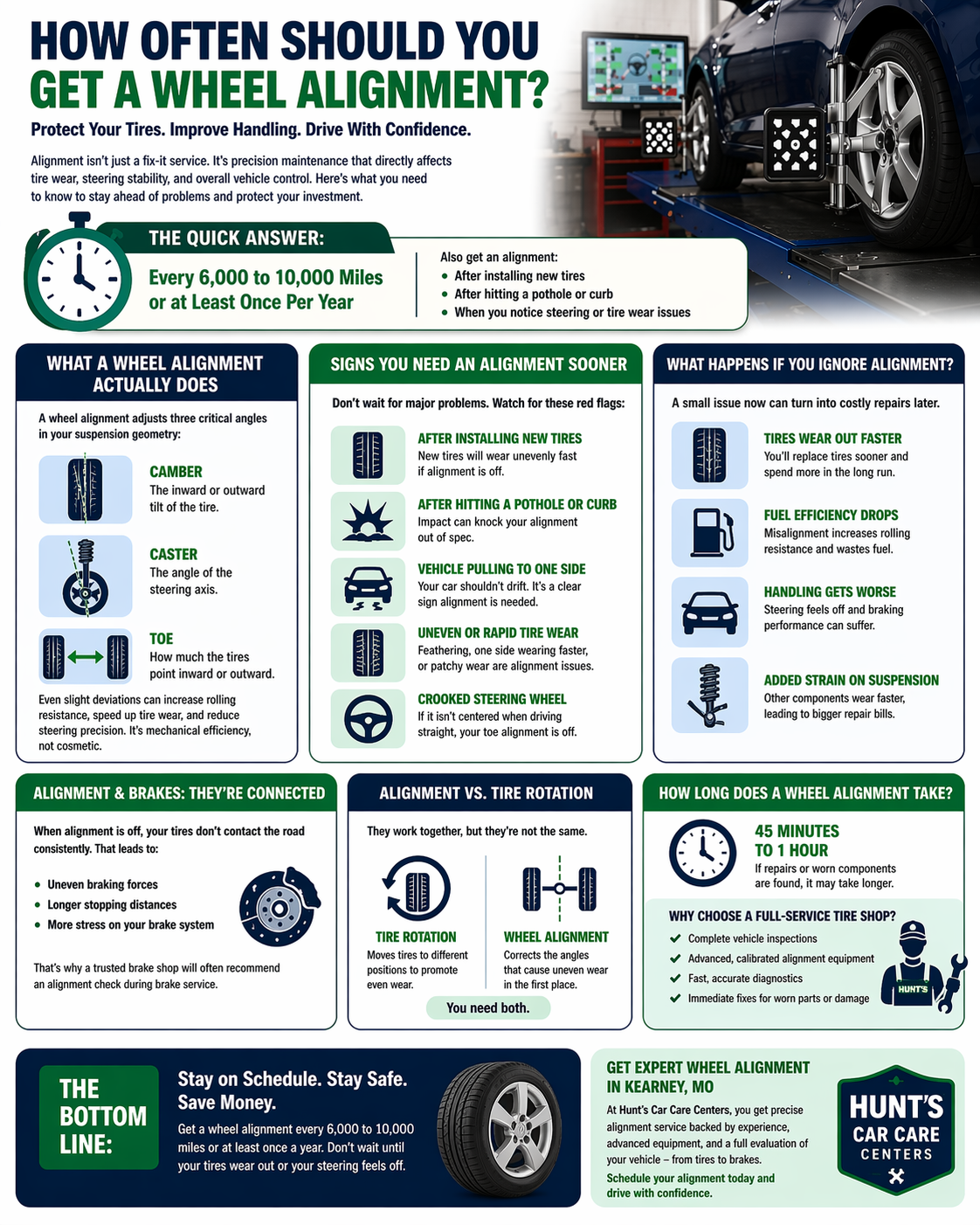
f you’re wondering how often you should get a wheel alignment, you’re already ahead of most drivers. Alignment isn’t just a “fix it when it’s broken” service, it’s a precision adjustment that directly impacts tire wear, steering stability, and overall vehicle control.
At Hunt’s Car Care Centers in Kearney, MO, alignment checks are treated as part of a broader vehicle health strategy, not an afterthought. Here’s what actually matters when determining alignment intervals, and when you should schedule service at a trusted tire shop or brake shop.
What a Wheel Alignment Actually Does
A wheel alignment adjusts three critical angles in your suspension geometry:
- Camber: The inward or outward tilt of the tire
- Caster: The angle of the steering axis
- Toe: How much the tires point inward or outward
Even slight deviations (fractions of a degree) can cause measurable problems. Misalignment increases rolling resistance, accelerates tread wear, and reduces steering precision.
This isn’t cosmetic. It’s mechanical efficiency.
Standard Alignment Interval: Mileage Guidelines
For most vehicles, the baseline recommendation is:
- Every 6,000 to 10,000 miles, or
- At least once per year
That mileage range intentionally aligns closely with tire rotation intervals. Pairing wheel alignments with routine maintenance reduces the risk of uneven wear patterns developing between service visits.
However, this is just a starting point, not a rule.
Driving conditions, vehicle type, and road quality all influence how quickly alignment drifts.
When You Should Get an Alignment Sooner
Mileage intervals don’t account for real-world driving. In practice, alignment issues are often triggered by events rather than time.
You should get your alignment checked immediately if you experience:
After Installing New Tires
New tires expose alignment issues instantly. If your suspension geometry is off, you’ll wear down fresh tread unevenly within a few thousand miles.
This is one of the most common (and most preventable) mistakes drivers make.
After Hitting a Pothole or Curb
Impact forces transfer directly through your suspension components. Even a single hard hit can shift alignment angles out of spec.
In regions with rough roads or seasonal damage, this is a frequent cause of misalignment.
Vehicle Pulling to One Side
If your car drifts left or right on a straight road, your alignment is already compromised.
This is not something to “monitor.” It’s a service trigger.
Uneven or Rapid Tire Wear
Look for:
- Feathering along tread edges
- One side wearing faster than the other
- Patchy or diagonal wear patterns
These are alignment signatures, not tire defects.
Crooked Steering Wheel
If your steering wheel isn’t centered when driving straight, your toe alignment is off. That means your tires are not tracking correctly.
What Happens If You Ignore Alignment?
Skipping alignment service doesn’t just wear out tires faster; it compounds mechanical inefficiencies.
Here’s what actually happens:
- Accelerated tire degradation reduces lifespan by thousands of miles.
- Reduced fuel efficiency increases rolling resistance.
- Handling is compromised, especially during braking and cornering.
- Strain on suspension components is increased.
Eventually, what started as a minor alignment issue becomes more costly repairs.
Alignment and Brake System Interaction
Most drivers don’t connect alignment issues with braking performance, but they should.
When alignment is off:
- Tires don’t maintain consistent road contact.
- Braking forces become uneven across the axle.
- Stopping distances can increase.
This is why experienced technicians at a full-service brake shop will often recommend an alignment check during brake service. The two systems are directly linked through tire-road interaction.
How Driving Habits Affect Alignment Frequency
Not all drivers need alignments at the same interval. You’ll likely need more frequent checks if you:
- Drive on uneven or poorly maintained roads
- Regularly encounter construction zones or debris
- Carry heavy loads or tow frequently
- Drive a performance vehicle with tighter tolerances
Conversely, highway-only drivers on well-maintained roads may stretch intervals slightly, but skipping annual checks still isn’t advisable.
Alignment vs. Tire Rotation: Not the Same Thing
This confusion costs drivers money.
- Tire rotation moves tires to different positions to promote even wear
- Wheel alignment corrects the angles that cause uneven wear in the first place
Rotation without alignment is reactive. Alignment is corrective.
You need both.
How Long Does a Wheel Alignment Take?
A standard alignment typically takes:
- 45 minutes to one hour
If suspension components are worn or adjustments are difficult, it can take longer. Shops like Hunt’s Car Care Centers use modern alignment systems that measure angles digitally, reducing guesswork and improving precision.
Why Choose a Full-Service Tire Shop for Alignments?
Not all alignment services are equal. A dedicated tire shop with full-service capabilities offers:
- Integrated inspections (tires, suspension, steering components)
- Accurate diagnostics using calibrated alignment equipment
- Immediate correction of related issues (worn parts, tire damage, etc.)
At Hunt’s Car Care Centers, alignment isn’t treated as a standalone service. It’s part of a comprehensive approach to vehicle maintenance.
That matters because alignment issues rarely exist in isolation.
How Often Should You Get a Wheel Alignment?
Here’s the practical answer:
- Every 6,000 to 10,000 miles or once per year
- Immediately after installing new tires
- Anytime you notice steering, handling, or tire wear issues
- After impacts like potholes or curbs
If you’re unsure, don’t guess. Alignment problems are measurable and easy to diagnose with the right equipment.
Get Expert Wheel Alignment in Kearney, MO
At Hunt’s Car Care Centers, you’re getting a full evaluation of how your vehicle interacts with the road.
From tire inspections to brake system checks, their experienced team delivers precise, reliable service backed by real diagnostics, not assumptions.
If your vehicle isn’t tracking straight, your tires are wearing unevenly, or you’ve recently installed new tires, now is the time to schedule an alignment.